A dwabi game · Episode 1

Embers of Dawn

Read the life of a far world. Survive its nights. Send word home.

Episode 1 · In development
Genre
Forgiving exploration and discovery
Setting
A wild alpine valley on a far world
Play
In your browser, on desktop and laptop
Status
Episode 1, in development

The story

Home is failing.

A corruption is spreading through it. They call it the Umbra, and it turns animals, and people, into darker versions of themselves.

Home traced it to a handful of far worlds, far even by their standards. The Survey sends explorers to them one at a time, to read the life of each world, survive it, and send the results home. Every world completed brings them a little closer to understanding the Umbra, and to ending it.

She is Explorer 62: the sixty-second explorer Home has sent, and the third to this valley. Explorers are grown carrying the knowledge of everyone who went before. Hers carries none of it. Something went wrong.

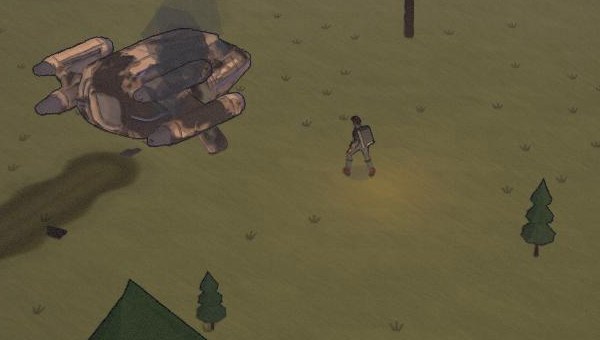
Her pod came down hard in a clearing at the foot of the mountains. It's damaged, but it's hers, and mending it is where everything begins.

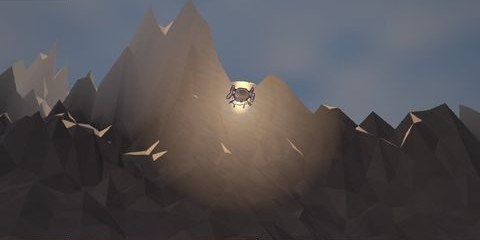
  1. A glowing pod streaks down past jagged mountain peaks at duskDusk. A light over the peaks.
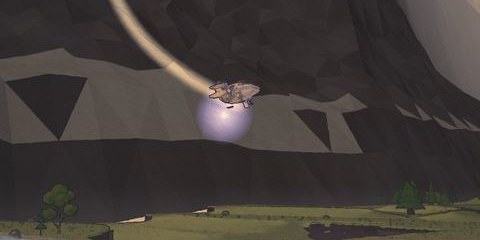
  2. The pod trails smoke as it drops toward the valley floorToo fast, too low.
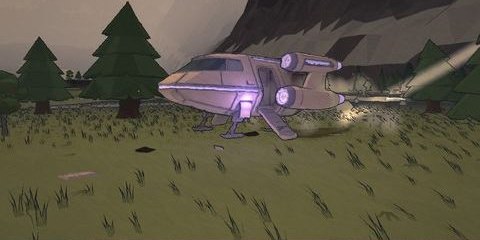
  3. The pod slams down on the meadow among the pines, engines glowing violetPlanetfall.
  4. Explorer 62 stands in the meadow beside her scarred, smoking podDay one.

Planetfall: the opening of Episode 1, from the game.

Two explorers came here before her. Somewhere in the valley, what they left behind is waiting.

This valley is Episode 1. Embers of Dawn is told across worlds: each episode takes Explorer 62, and the story, a little further from home.

Those who came before

Two explorers. Twelve fogged plates.

Explorer 17 came to this valley first, and Explorer 48 after her. Neither of them went home.

Their plates are still out there, fogged by years and by the Umbra. Find the spot where one was taken, line up its faint ghost in your lens, and take it again. Back at camp the plate reader develops the old plate against yours, then and now, side by side.

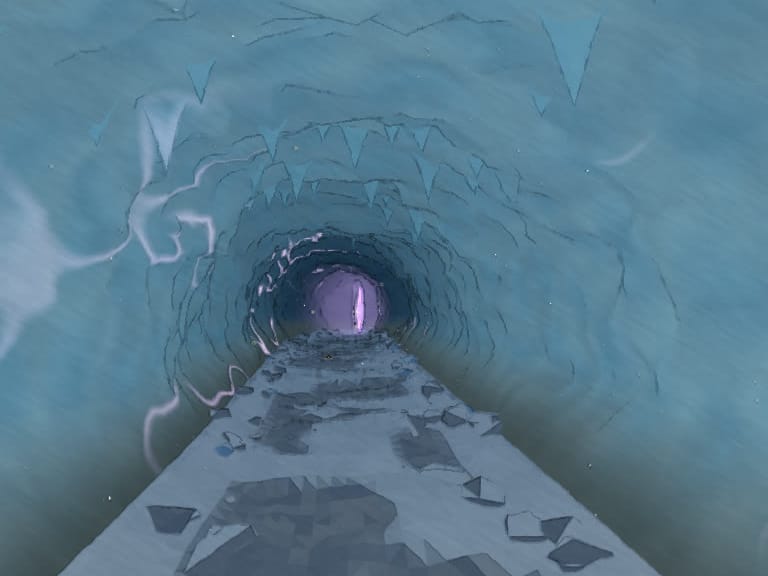
Follow 17’s plates far enough and, one warm afternoon, the glacier opens. You walk in on foot. 48’s plates are waiting in her own craft.

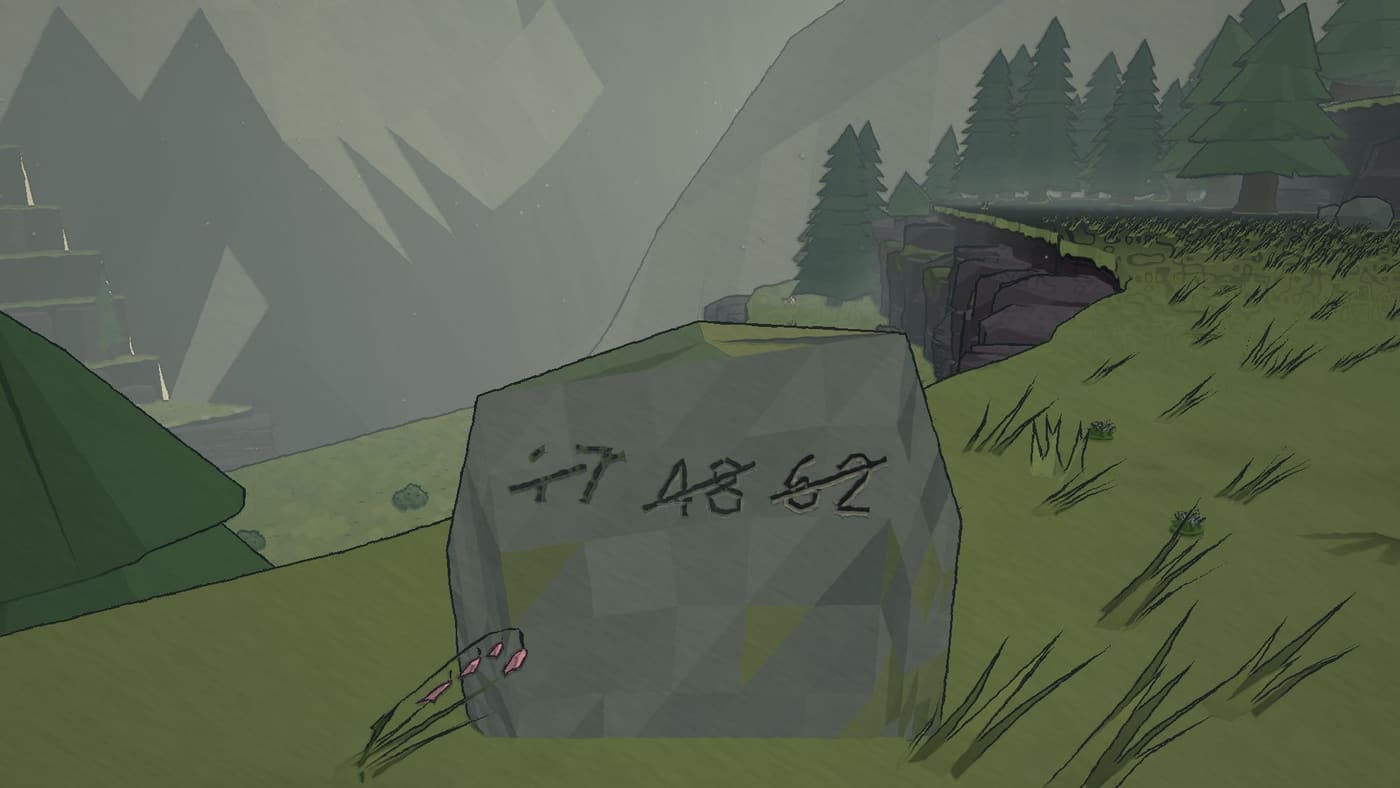
Above the western gorge there’s a stone with their numbers cut into it. You can cut yours beside them.

A grey stone on a grassy ledge with the numbers 17, 48 and 62 cut into it and struck through
The number stone above the western gorge.
A tunnel of blue ice leading to a violet glow
Inside the ice.
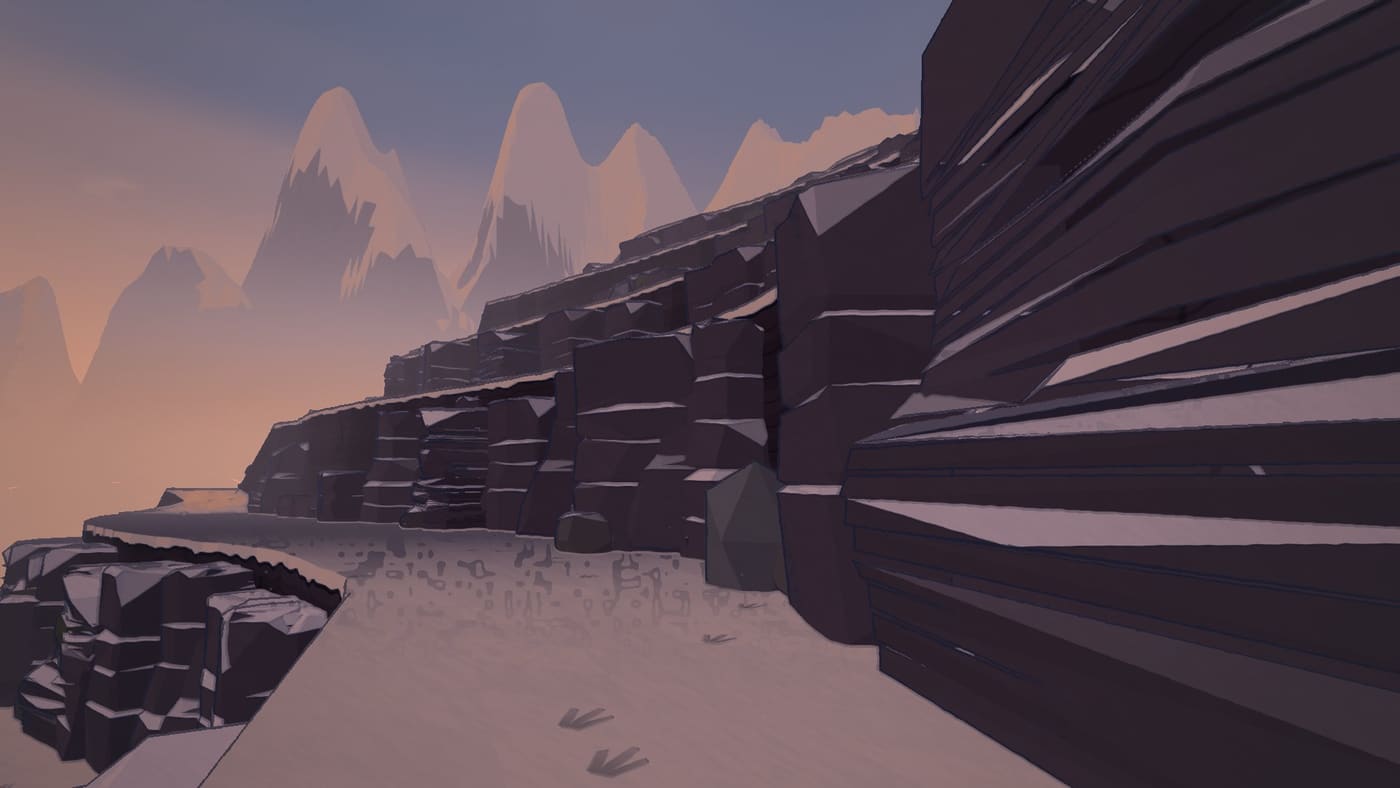
A snowy ledge below glowing peaks at first light
Somewhere high, at first light.

Her companion

Meet Nib.

Every explorer is sent with a nanosquid: a small nanotech companion, grown in the pod alongside her. It’s meant to be a tool with a little animal sense in it. Hers is more.

She calls him Nib. He flies to the lip of a cliff on a lit filament, bites the rock and reels her up. When something comes too close, he flares a ring of light-ink, the opposite of a squid’s dark ink, to startle it away.

Nib is curious, wary and fond of her, and he has moods. Mostly he speaks in light. Every so often he manages a word, and he always says it twice.

Docked, in flight, asleep on her shoulder, and flaring light-ink.

The little things

Nib is mostly quiet. That’s what makes his moments count.

  • He always tries. Ask him for a wall that’s too high and he flies anyway, falls just short, and comes back drooping, his light a sheepish amber. “Too high too high.”
  • He sees them first. Long before you spot the herd, Nib has. He’s up on your wrist, alert, with a “look look” to point the way.
  • He’s proud of you. Take a three-star photograph and he flares bright and chirps “pretty pretty”, as if he took the shot himself.
  • He has a soft heart. Ask him to drive off a calf and you’ll get a firm “no no”. You won’t want to ask again.
  • He knows where home is. When night falls he curls up on your shoulder by the ward’s blue fire, his light slow and dim, breathing as he sleeps.
  • He loves a pat. The first one gets an “ok ok”. Keep going and, well, he has opinions.

After dark, a faint lavender shows at the tips of his arms. The change that takes the valley’s animals each night pulls at Nib too. So far, Nib holds, and what he’s becoming is a story that runs across the episodes.

After his first flight she names him Nib, and he says it back to her. Twice.

From the artbook

Designing Nib

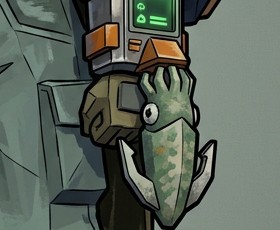
  1. Early concept art: a squid-shaped grapple held at her wrist, below a boxy wrist unit with a green screen 1 · First sketches

    Early concept art imagined a squid-shaped grappling hook: just a tool, with no character yet.

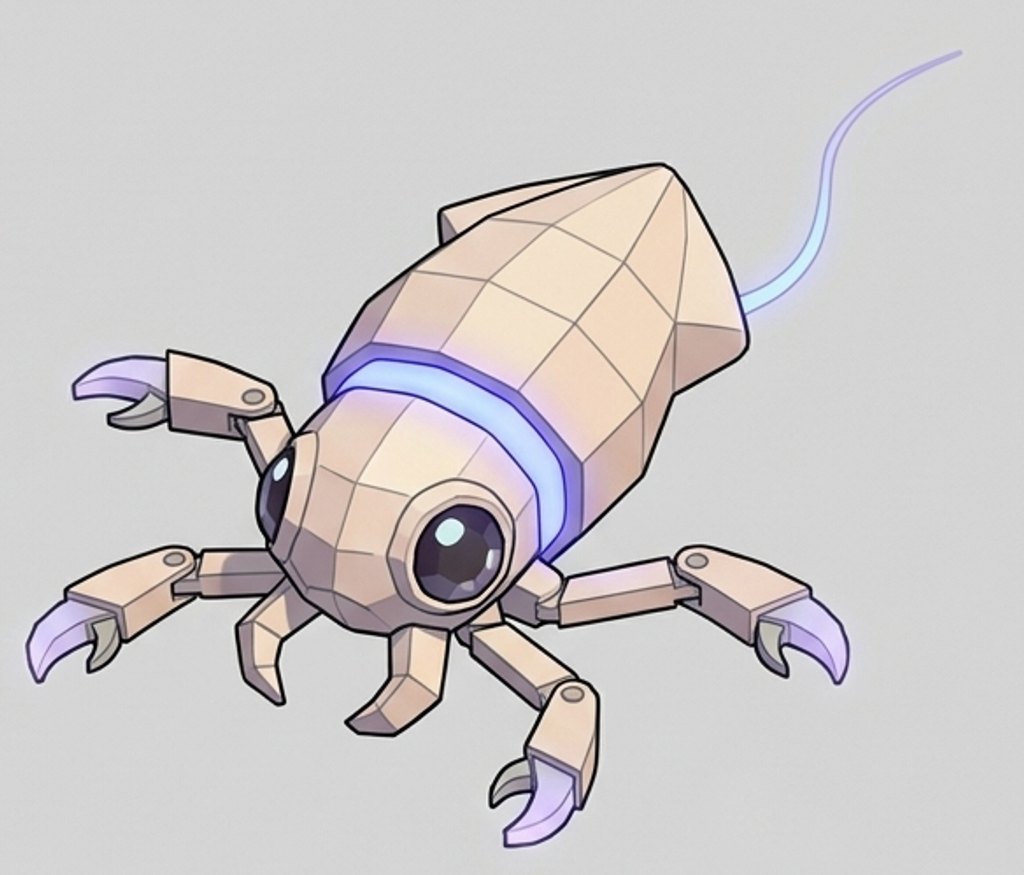
  2. Concept art of Nib in flight 2 · Nib appears

    The design changed course: a companion, not a tool. One big eye, a blue-violet band, and lavender at his claw tips.

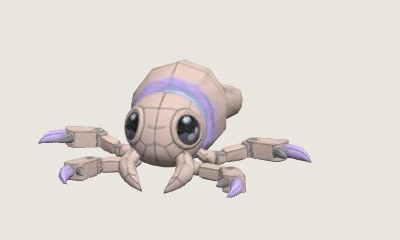
  3. Nib's 3D model: a pale faceted body, two glossy eyes, the violet band and lavender claw tips 3 · Modelled

    Built from its flying pose, sized to read clearly from the game’s high camera.

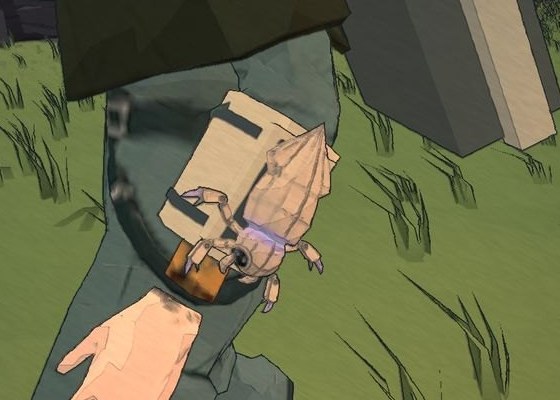
  4. In the game: Nib docked in his cradle on her forearm, eyes toward her hand 4 · In the game

    Docked in his cradle on her forearm, eyes to her hand, band lit by his mood.

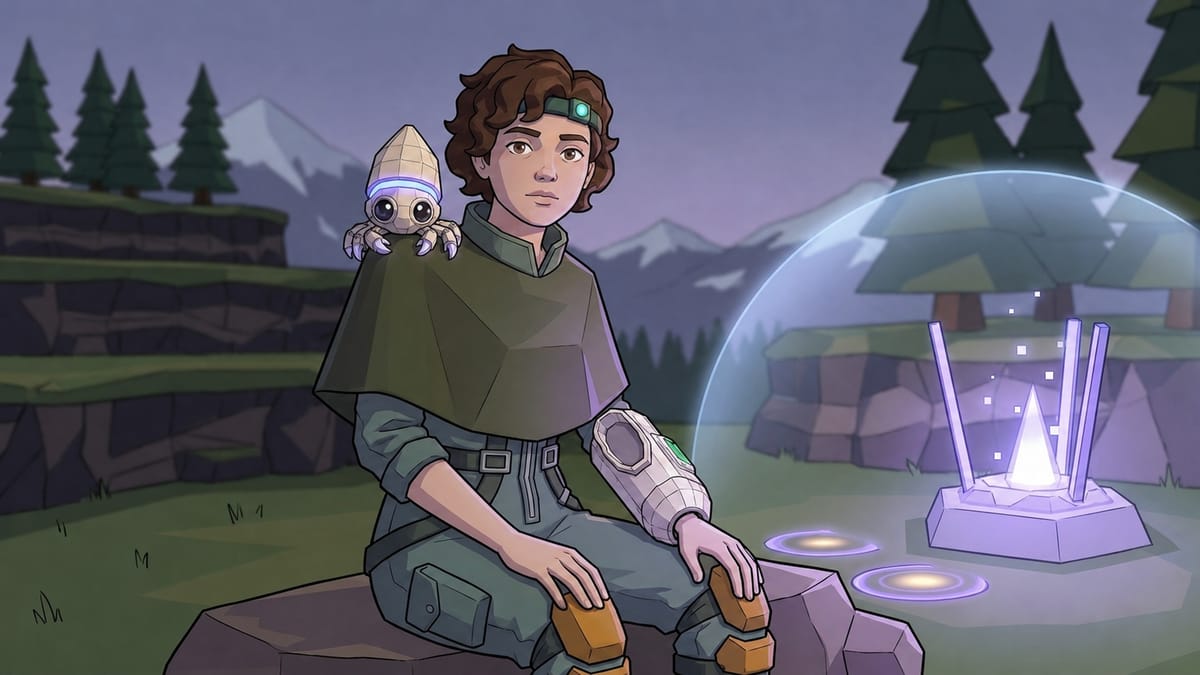
Illustration of Explorer 62 sitting on a rock outside her camp at dusk, Nib perched on her shoulder, the camp’s crystal hearth glowing violet beside her

She speaks

You’ll hear her before long.

Explorer 62 talks. To herself, to Nib, now and then to the valley: about the weather, the time of day, how hungry she is, and whatever just walked past. More than five hundred lines, all recorded, and the pod has a voice of its own.

There’s a score now too. Felt piano, soft strings and bowed glass, with pieces for each part of the day, for rain and snow and mist, for camp at night and the high places. It plays for a while, then stops, and leaves the valley to its own sounds.

Everything she says is captioned, and she has her own volume slider if you’d rather she kept quiet.

By day, by night

The valley changes after dark.

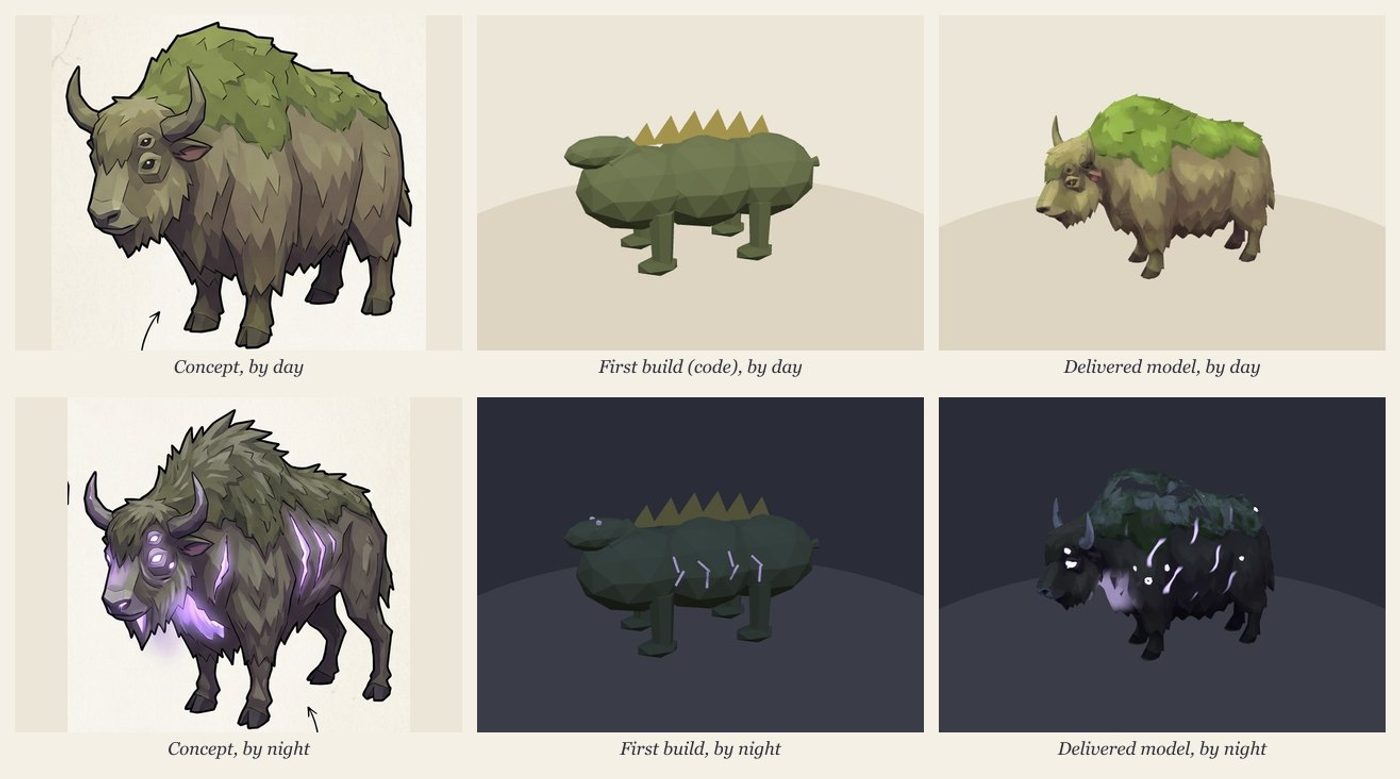
By day, the creatures here are simply themselves. At night, under the moons and the aurora, the trace of the Umbra they carry wakes. Their look shifts, and their temper with it.

Her camera is no camera. It's a spectrograph: it reads the biology of every creature, and the signature of whatever is working on it. To study a species she needs all four parts:

Day imageFramed, graded, sealed on a plate.
Day readingHeld close, for long enough.
Night imageThe same animal, changed.
Night readingGet close, and stay calm.
Six panels showing the Mossback Grazer as a concept sketch, a first code build and the delivered model, by day and by night: by night it turns gaunt, with violet light in its eyes and flanks
The Mossback Grazer by day and by night: concept, first build, and the model in the game.
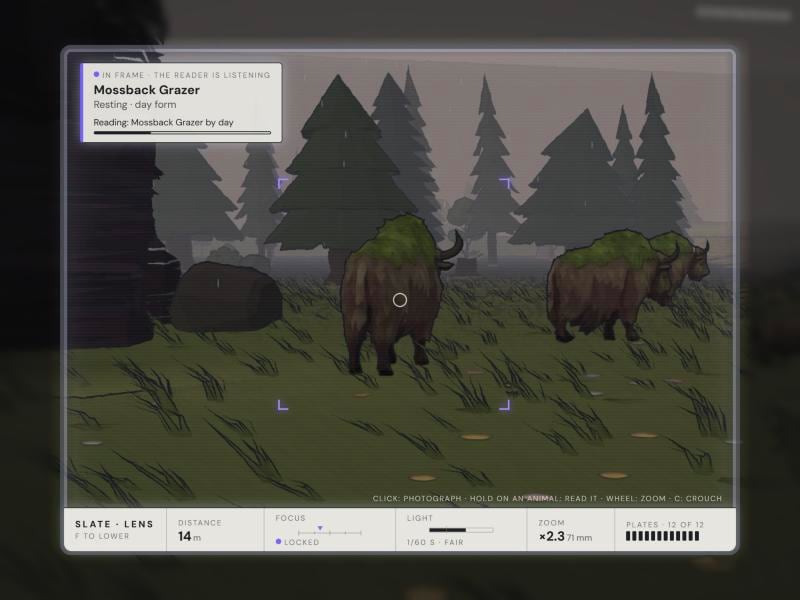
Two Mossback Grazers among misty pines, seen through the slate lens, the violet focus box locked on one of them

Photography

The lens is the heart of it.

Almost everything in Embers comes back to a photograph. You creep in downwind, wait for the animal to do something worth seeing, and press the shutter. Back at camp, the plate reader tells you what you’ve learned.

The lens has proper focus and a light meter, so dusk shots take a steady hand. There are sixty-seven prize shots to chase, too.

The field guide

The life of the valley.

Eight species live in the valley, from palm-sized lizards to things you'd rather see from a distance. Here are the first four she'll meet.

Burrow Skink

Old lineage · Common

By day
A palm-sized crested lizard, sand and umber, basking on warm rock. Darts into cracks if you move quickly, and peeks back out if you keep still.
By night
The glimmer. Crests raised, the Umbra's violet in their throats, flitting through the grass in twitchy little groups.
Pine Glider

Earth-kin · Uncommon

By day
Blue-grey fur and burnt-orange gliding membranes. It keeps to the crowns of the denser pine groves, and comes down to feed in the early morning and late afternoon.
By night
The lamp-moth. Its membranes veined with faint violet light. Drawn to light, it circles the ward's glow, but won't cross its edge.

Mossback Grazer

Earth-kin · Common, in herds

By day
The valley's big, gentle herd animal: four eyes, short curved horns, and a living mantle of moss on its back. Grazes heads-down, backs to the wind.
By night
The vigil. The herd stops grazing and stands in a ring, calves inside, faces out, still and watching. Best read from a ledge above.

Riverstalk Wader

Water lineage · Uncommon

By day
A tall, heron-like river bird with a frilled, gill-like crest. Still as a post in the shallows at dawn and dusk; at dusk, groups bow to one another on the gravel islands.
By night
The sentinel. Its crest locked open and lit violet, it stands in the shallows all night. Read it from the bank. Never wade.

The creatures' calls are made from public-domain recordings of Earth animals by the US National Park Service, reshaped until they belong to the valley.

The slate

Everything she learns, in her hand.

Projected from her wrist unit, the slate is a slim, paper-grey panel: part field journal, part map, part lifeline. It's where the valley starts to make sense.

  • The index. Every species she meets, by day and by night, sketched and annotated as she learns them.
  • The forecast. Rain, clear skies and mist, hours ahead, so the rare nights can be planned for.
  • The map. Camps, cairns, high places and the trail of what she's found, drawn as she goes.
  • The pack. What the valley offers, where to find it, and what it can become.
  • Messages from Home. Arriving out of order, years late, as she mends the pod.
The codexHow the valley works, written as she learns it.
The mapHand-drawn contours, filled in as she explores.
The packTimber, stone, resin and berries, and what each becomes.

Her kit

Everything Home sent with her.

A flight suit, an olive poncho, ochre guards so she reads against the green, and a pack full of the Survey's technology.

The spectrograph

Her camera and her science. Frame a creature, then read the biology of it, and whatever is working on it, by day and by night.

Nib

Grapple and guardian in one. Her nanosquid flies to the cliff’s lip, bites and reels her up, and flares light-ink when the night comes too close. Meet Nib

The nanotech ladder

A way down any wall. A slim bar on her pack unfolds into a ladder. Fold it away again, and the night can’t follow.

The drop booster

Step off the ledge. A warm glow at the base of her pack catches her fall and softens the landing.

The ward

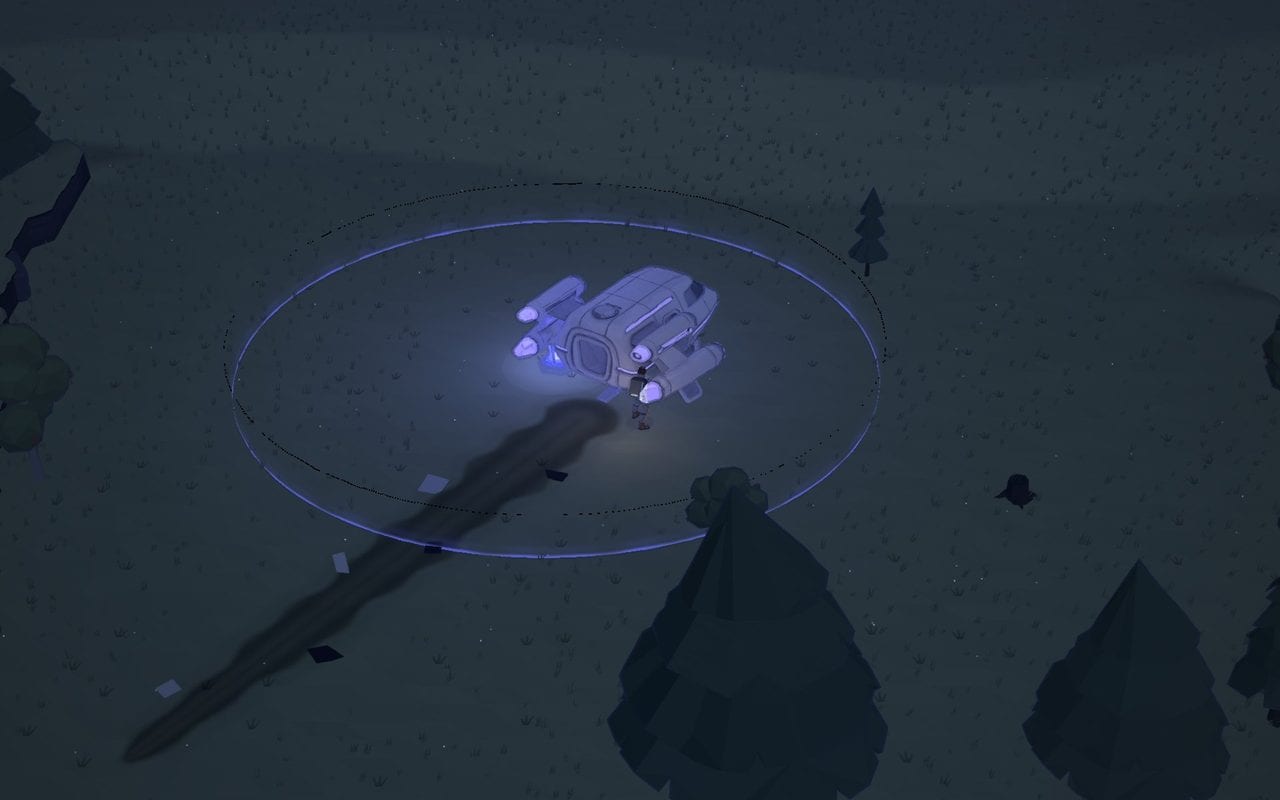
A fire that keeps watch. Set it down at camp and it burns blue. The things of the night stop at its edge.

Nanoplates

One moment, sealed for good. Every shot is written to its own plate with everything she sensed in that instant: a record no one can copy or fake.

Concept art

Built for the climb.

  • On her forearm: Nib’s cradle, a sleeve of the pod’s pale hull. The green screen on its face projects the slate, and a blue-violet seam glows with Nib’s light while he’s home.
  • On her back: a compact pack, the ladder folded along its edge, and the booster’s warm glow at its base.
  • Higher ground: some places can only be reached with the gear, and its reach grows as she repairs the pod’s fabricator, so taller cliffs open up over time.
At night, Explorer 62 stands beside her pod inside the blue ring of the ward

Forgiving by design

Danger, gently.

There's real peril in the valley after dark: a herd that charges, a serpent that coils in the rain. But nothing here is built to punish you. It's built to be planned for, and survived.

  • Turn the charge with light. Nib flares a ring of light-ink and a creature wheels away. Bigger creatures drain more of the charge, so pick your moment.
  • Climb out of reach. Most night creatures can’t climb. Find a ledge, fold the ladder away, and watch the valley go by below.
  • Keep the fire lit. Inside the ward’s blue fire, the night waits outside.
  • Lose time, never progress. Take a fall or have a bad night, and you wake back at camp with everything you’ve found.
  • Read the sky. The slate’s forecast shows rain, mist and clear nights coming, so you can choose when to go out, and when to stay in.
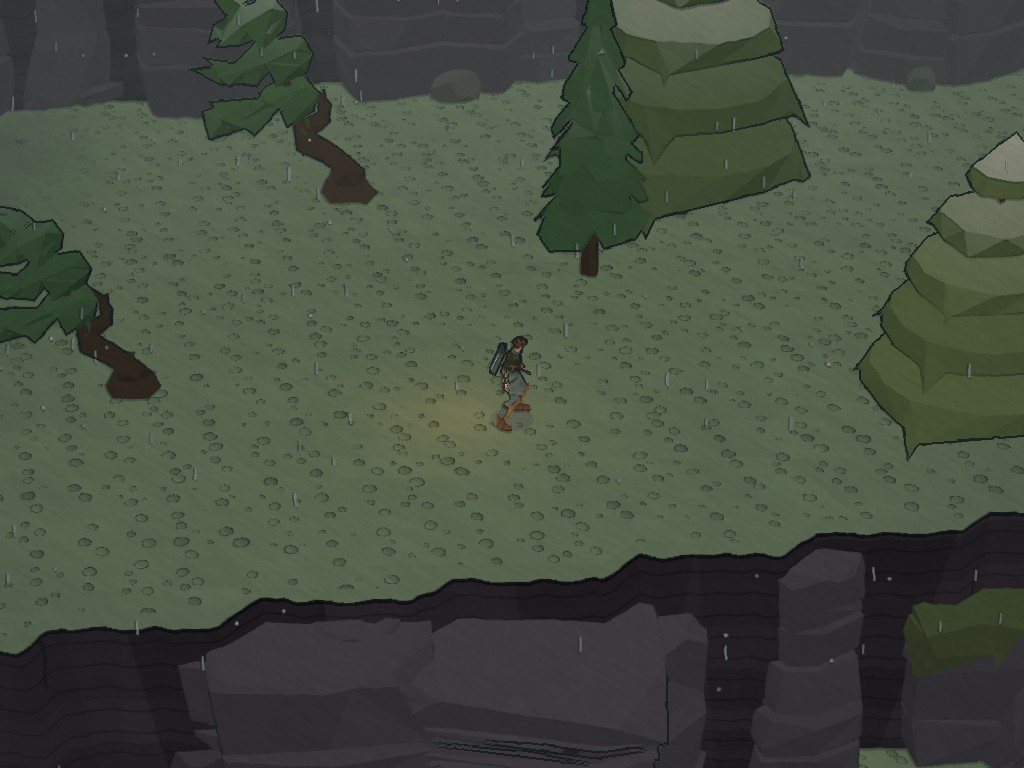
Explorer 62 crosses a high grassy plateau in the rain, between windswept pines and dark cliffs
Rain on the high plateaus
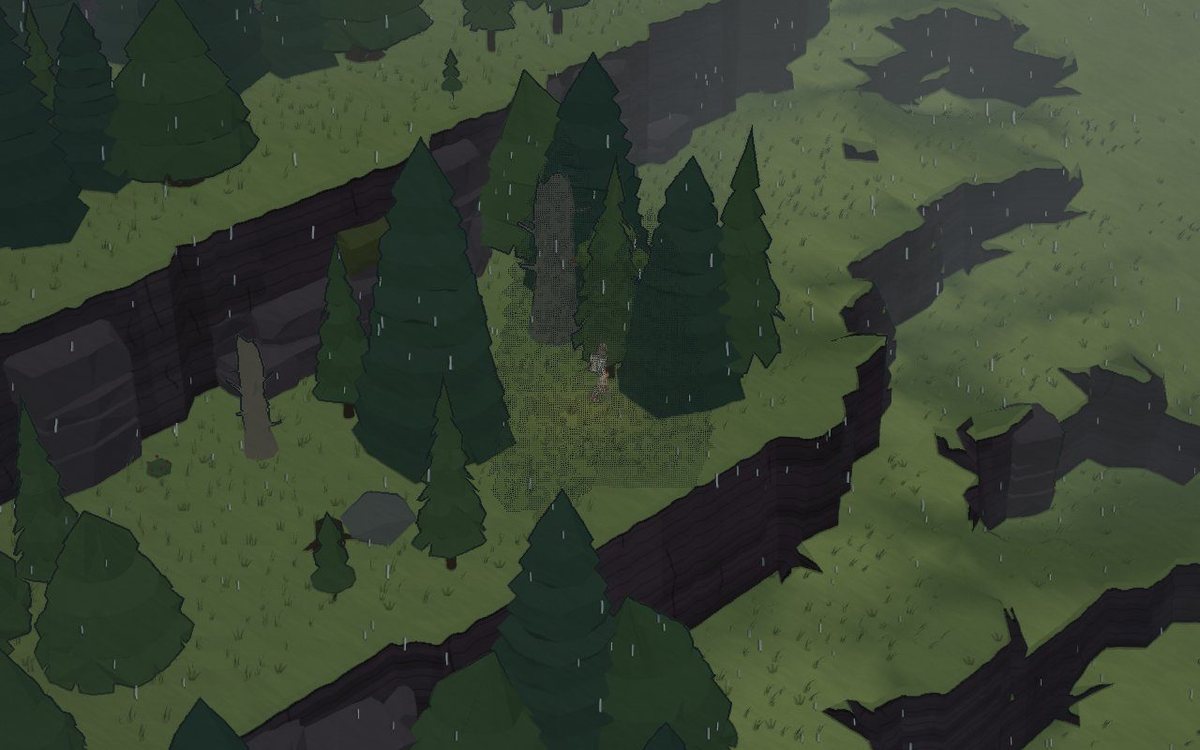
A dense pine grove on a terrace, seen from above in falling rain
A pine grove in the rain

The artbook

A diorama of plates.

Every model and every screen in Embers of Dawn is built and judged against one art guide. Here are its five rules, its palette, and some of the pieces the valley was made from.

  1. A diorama of plates.Flat grassy plates stacked on dark rock. Every terrace edge is a visible cliff band.
  2. Light tops, dark faces.Squint at a screenshot: the terraces must still read.
  3. Few, large, faceted shapes.Detail from a handful of deliberate things, never from pattern.
  4. Muted and cool, with one warm accent.The only warm colour is lantern-fire orange, so it always draws the eye.
  5. Atmosphere carries depth.Mist and fog, not detail, separate near from far.
Plateau grass Cliff face Water Gravel banks Snow Mist Trunks Lantern fire
The primary conceptThe terrace form everything is built from.
The meadowsGround, paths and the grassy lip over each cliff.
The treelineScree, snowfields and peaks fading into mist.
The Survey's shuttleHer pod, before the crash.
In the engineAn early style test of the terraces.

The living valley

A world that keeps happening.

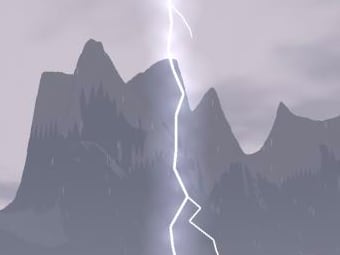
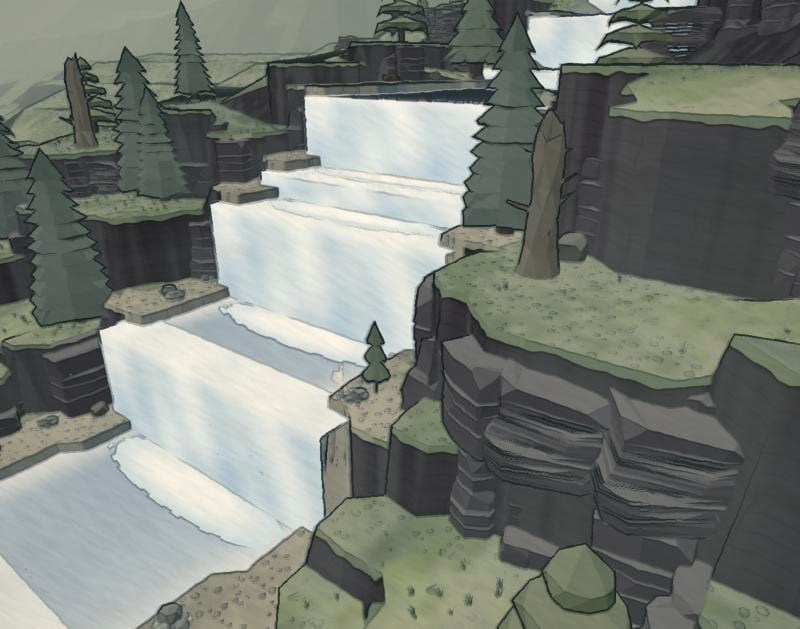
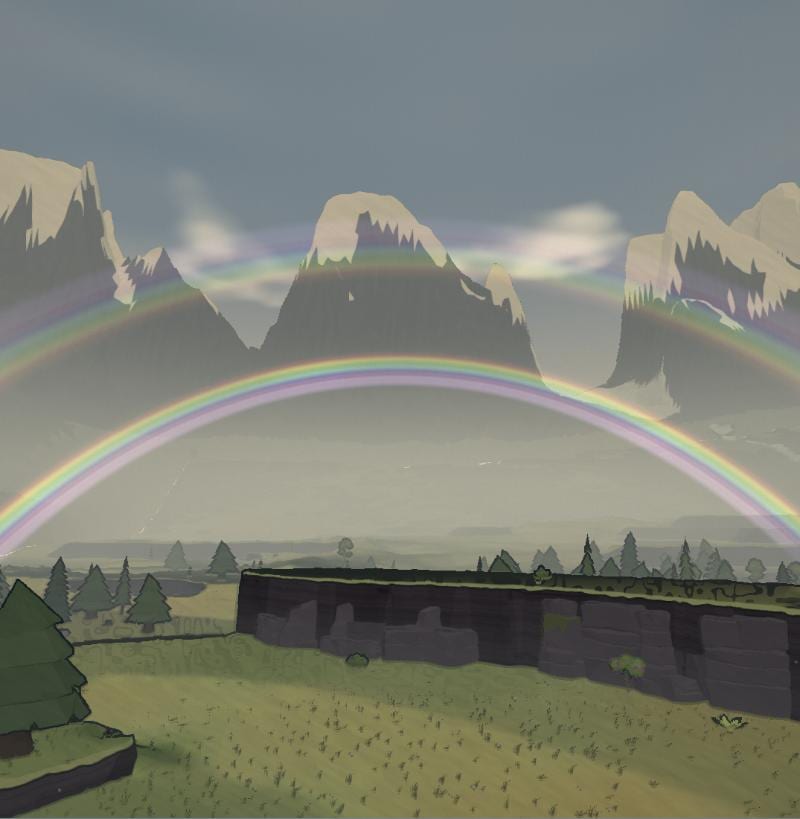
The weather runs to its own seeded forecast and the herds walk their own trails. Now and then something rare happens, like every waterfall freezing mid-pour. All of it runs in your browser, on an engine we wrote ourselves.

Lightning striking past grey crags A waterfall frozen mid-pour A double rainbow over a cliff band Violet light glowing under a dark lake

In development

The valley is still taking shape.

This valley is Episode 1 of Embers of Dawn, and it's being built one phase at a time. There's nothing to play just yet, but when there is, you'll play it right here in your browser. We'll share more as it grows.